
Pupil Equity Fund and Cost of the School Day
At East Calder Primary School, we are committed to reducing the cost of the school day so that financial pressures never limit a child's learning, participation or wellbeing.
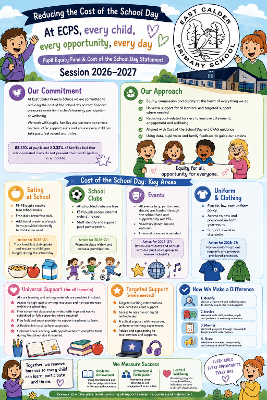
We recognise that the cost of school life can create barriers for families and that these barriers can negatively impact children's confidence, engagement and attainment if they are not addressed proactively.
Our approach is guided by the principles of equity, compassion and dignity, and is aligned with Cost of the School Day and CPAG guidance. We work closely with pupils, families and partners to identify and remove cost‑related barriers at the earliest opportunity. We aim to remove any stigma associated with asking for help and ensure support is offered sensitively, confidentially and respectfully, so that every child can participate fully in school life and no one misses out due to cost.
Encouragingly, our most recent ethos survey indicates that 83.33% of pupils and 80.32% of families feel that school‑related costs do not prevent their participation in school life.
Contextual Analysis
East Calder Primary School serves a diverse community within West Lothian, encompassing a broad range of socio‑economic backgrounds. According to the Scottish Index of Multiple Deprivation (SIMD 2020), a number of our pupils live in areas ranked within the lower SIMD quintiles. This presents potential barriers to attainment, wellbeing and participation.
Through ongoing data analysis - including SIMD data, Free School Meal (FSM) registrations and internal assessment evidence - we have identified clear gaps in attainment and engagement. Key areas requiring support include literacy, numeracy and health and wellbeing.
To respond effectively, we adopt a blended approach of universal supports for all learners, alongside targeted interventions for those who require additional help. This ensures every pupil has the opportunity to thrive.
Equity, Writing and the Cost of the School Day
Improving attainment, engagement and confidence in writing is a key school improvement priority for session 2026-2027. We recognise that cost‑related barriers can affect access to rich writing experiences, learning resources and opportunities to develop language, creativity and learner voice.
Reducing the Cost of the School Day is a key enabler within this priority. By ensuring that writing resources, learning experiences and support are provided equitably, we reduce variation in opportunity and support all learners to participate fully and succeed as writers, regardless of personal or family circumstances.
Universal Support (for all learners)
To remove barriers and promote equity, we provide the following universal supports:
- All core learning and writing materials are provided in school.
- Access to high‑quality writing resources and rich learning experiences within the school day.
- Free school‑led clubs and activities, with trips and events subsidised or fully supported where required.
- Free fruit and snack provision to support readiness to learn.
- A flexible, low‑cost uniform approach, including access to new and pre‑loved items.
- Optional home learning, with opportunities for children to complete tasks during the school day if required.
Targeted Support (where needed)
Where additional support is required, this is provided discreetly and sensitively and may include:
- Targeted writing interventions and increased adult support.
- Access to assistive or digital technologies to support learning.
- Practical support with resources, uniform or learning experiences.
- Advice and signposting to local services and supports.
Actions and Implementation Plan
To ensure our approach is effective and evidence‑based, we will:
- Use attainment and wellbeing data to identify pupils requiring support.
- Engage stakeholders to co‑design interventions with staff, families, pupils and community partners.
- Monitor and evaluate impact through measurable targets and termly reviews.
- Share outcomes transparently, demonstrating how PEF is used and the difference it makes.
Monitoring and Evaluation
We will measure success through a framework that tracks improvements in:
- Academic Achievement: Using standardised and teacher judgement data in literacy and numeracy.
- Attendance & Participation: Monitoring school attendance and engagement with school activities.
- Health & Wellbeing: Assessing progress through wellbeing indicators, surveys, and staff observations.
Review cycles will take place termly, ensuring all supports remain responsive and high-impact.
Cost of the School Day: Key Areas
Events
- Universal & Targeted: All events (e.g., pantomime, discos) are funded through the school fund and supported by the Parent Staff Council (PSC). Voluntary donations are optional, and financial pressure is avoided.
- Action for 2026-27: Continue reviewing event costs and consult with the pupil voice group to ensure inclusivity.
Eating at School
- Universal: P1-P5 pupils receive free school meals. A free daily breakfast club is offered.
- Targeted: Additional breakfast/snack items provided discreetly to children in need.
- Action for 2026-27: Track breakfast club uptake and identify ways to ensure no child goes hungry during the school day.
School Clubs
- Universal: All school-led clubs are free. FSM pupils access external clubs (e.g. Active Schools) at no cost.
- Targeted: Staff identify and support pupil participation through family engagement.
- Action for 2026-27: Consult pupils and expand club variety to boost engagement and wellbeing.
Home Learning
- Universal: Homework is optional. Where provided, pupils can complete tasks during the school day or access paper copies.
- Targeted: Homework clubs and device loans support learners without home access.
- Action for 2026-27: Audit digital access annually and adapt device support accordingly.
Getting Ready for School
- Universal: A flexible, low-cost uniform policy encourages plain/unbranded options.
- Targeted: A 'nearly new' uniform bank is promoted and available to all families.
- Action for 2026-27: Increase visibility and expand access to uniform donations.
Travelling to School
- Universal: The school catchment is well serviced. Most activities are delivered on-site.
- Targeted: Support is offered with transport applications where needed.
- Action for 2026-27: Monitor transport needs via feedback and referrals.
Friendships at School
- Universal: Equity is embedded in our culture through uniform, LEARN values, and inclusive language.
- Targeted: Nurture interventions include LEGO therapy, buddy systems, and emotion coaching.
- Action for 2026-27: Review wellbeing data and nurture referrals each term.
Learning at School
- Universal: All stationery is provided; digital tools are accessible. A flexible 'bring your own device' policy is in place.
- Targeted: PSWs lead targeted interventions in literacy, numeracy, and HWB.
- Action for 2026-27: Review PEF spending termly to ensure high-impact use.
School Trips
- Universal: One trip per class is arranged annually, with costs subsidised via fundraising and the PSC.
- Targeted: Full financial support is provided as needed.
- Action for 2026-27: Explore local trip opportunities and cost-saving partnerships.
Consultation on Pupil Equity Fund Spend
Each year, we consult with families, pupils, and staff to review current PEF strategies and inform future planning. This feedback directly shapes our School Improvement Plan and Standards and Quality Report.
- Action for 2026-27: Conduct consultation in Term 4, ensuring pupil voice remains central.
At East Calder Primary, our commitment to equity, wellbeing, and inclusion underpins every aspect of school life. Central to this is our dedication to tackling the cost of the school day, ensuring that every child, regardless of background or circumstance, can participate fully and thrive in an inclusive, nurturing environment.
Through thoughtful use of the Pupil Equity Fund, targeted supports, and strong community engagement, we proactively remove barriers and promote equity, dignity, and opportunity for all learners. Our Cost of the School Day and Pupil Equity planning reflect these values in action.
The following Quality Indicator evidence outlines how our strategies align with national expectations and demonstrates the positive impact of our ongoing efforts to close the attainment gap and support every pupil's success.
Quality Indicator 1.5: Management of Resources to Promote Equity
Key Expectations:
- Effective targeting of resources (including PEF) to address the poverty-related attainment gap.
- Use of data to identify need.
- Engagement with stakeholders in planning and evaluating impact.
- Sustainable approaches to resource use that build capacity.
At ECPS:
- Strong use of data (e.g., SIMD, FSM registrations, attainment tracking) to identify barriers to learning and participation.
- Clear targeting of resources (e.g., PEF interventions, assistive technology, subsidised trips/clubs).
- Participatory budgeting and consultation with pupils, families, and staff, promoting shared ownership and transparency.
- Planned evaluation mechanisms (termly reviews, data tracking, stakeholder feedback) to monitor the impact of equity-based interventions.
- Sustainable universal supports (e.g., device lending, free clubs, uniform bank) that build a culture of inclusion and reduce dependence on short-term funding.
Quality Indicator 3.1: Ensuring Wellbeing, Equality and Inclusion
Key Expectations:
- Wellbeing is at the heart of the school's work.
- Children's rights are respected and upheld.
- Inclusion and equality are central to all practices.
- All children are supported to overcome barriers and reach their potential.
At ECPS:
- Wellbeing-centred culture, with nurture, mental health support, emotional check-ins, buddy systems, and inclusive participation in school life.
- Respect for dignity and compassion - EQUITY, explicitly named as one of our core school values.
- Proactive identification and removal of barriers — especially cost-related ones — so no child is disadvantaged or excluded.
- Universal supports such as access to materials, digital inclusion, free clubs and flexible homework reflect a whole-child, rights-based ethos.
- Targeted support is sensitively implemented and based on individual need, reinforcing inclusion and safeguarding equity.
Families are encouraged to contact the school at any time. Help is always available - just ask.
Your Voice Matters
Pupils and parents are regularly consulted about barriers linked to cost and participation. Their views directly inform decisions around support, equity and the use of Pupil Equity Fund. This ensures our Cost of the School Day approach remains responsive, relevant and grounded in the lived experiences of our school community.
Measures of Success
We will measure success through improvement in the following areas:
- Improved attainment and progress in writing across all stages, evidenced through teacher judgement and moderation.
- Increased learner engagement, confidence and enjoyment in writing.
- Reduced gaps in writing attainment between identified groups of learners.
- Consistent access to writing resources, learning experiences and support for all learners.
- Increased consistency in inclusive, high‑quality writing pedagogy across the school.
Our Commitment
Together, we are committed to ensuring that no child misses out on learning, experiences or opportunities because of cost. Through our Cost of the School Day approach, and our focus on equity in writing, we continue to make East Calder Primary School a place where every child can participate fully, feel valued and thrive.


